

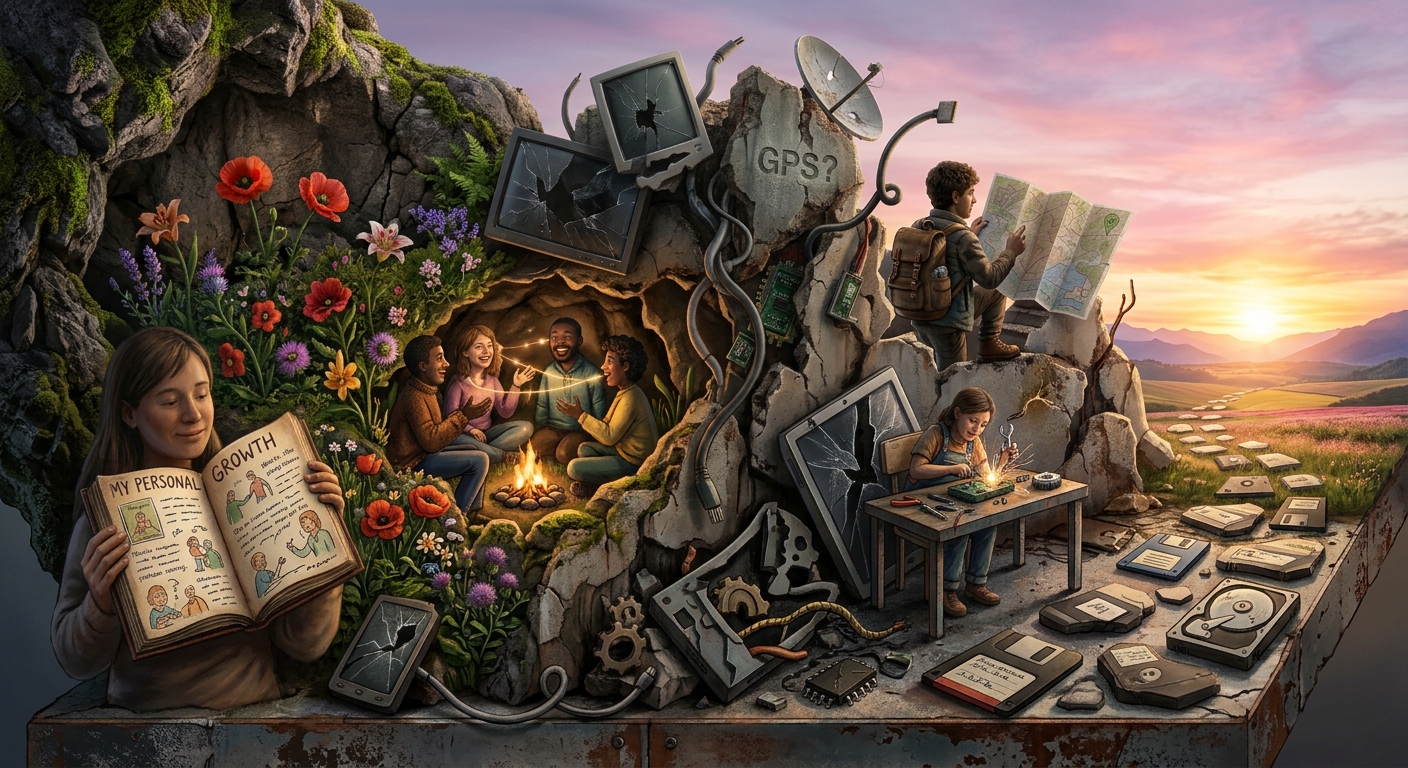
Every year around this time, someone asks me if I ever get tired of technology breaking. I have spent more than 35 years in this field, and the honest answer tends to surprise people. I am grateful for it. Not in a greeting-card way, but in the way you are grateful for the thing that turned out to teach you the most.
If there is anything technology is very good at, it is failing at the worst possible moment. A server picks the morning of a filing deadline. A laptop dies the Friday before a closing. I used to find that maddening. Somewhere in the last couple of decades I started seeing it differently, and it changed how I do the work.
Failure Is Honest
A machine that fails is telling you the truth about itself. The hard drive that dies was always going to die. The backup that does not restore was never really a backup, just a comforting folder somewhere that nobody tested. The failure only revealed a weakness that was already sitting there, usually one somebody was hoping to ignore.
I am grateful for that honesty because it is the only thing that reliably gets people to act. I can tell a client for two years that their backup is untested, and we can both nod and move on. One failed restore teaches the lesson in an afternoon. The breakage is the part that finally makes the invisible visible, and you cannot fix what you refuse to look at. Quiet failure is why your back up strategy is probably broken.
Failure Keeps Us Humble About the Shiny Stuff
This matters more in 2026 than it used to, because we are living through the loudest technology hype cycle of my career. Every week a vendor promises that some new tool will never fail and never needs a human standing behind it. I have been doing this long enough to have heard that promise before. I heard it about client-server computing in the nineties and about the cloud a decade later, and now I am hearing it about AI.
The tools are real and some of them are genuinely useful. The promise that they sit above failure is the part I do not believe, and I am grateful for every outage that keeps me honest about it. An MIT study of enterprise AI in 2025 found that about 95 percent of generative AI pilots delivered no measurable impact on the bottom line. Technology is built by humans and inherits every one of our limits. A tool that cannot fail has not been invented yet. It has just not failed in front of you.
The Failures Point Back to People
This is the part I care about. When I trace a bad day back to its root, it almost never ends at a machine. It ends at a person who was rushed, or set up to fail by a system nobody designed on purpose.
The data keeps agreeing. Verizon’s 2025 Data Breach Investigations Report found the human element involved in roughly 60 percent of breaches. I do not read that as a story about careless employees. I read it as proof that humans are the center of gravity, which is exactly where I have always believed the job lives. Fix the technology and you solve today. Understand the person using it and you prevent next year.
That is why the standing rule at our company is that we will not hire a technician who likes machines more than people. A brilliant engineer who cannot sit calmly with a frightened office manager at 7am is not much use to the person having the worst morning of their quarter. That human instinct is the whole product, which is something we get into in our piece on the family doctor versus urgent care approach to IT support. Technology is just an excuse. The job is understanding how a business runs and staying a step ahead of whatever might interrupt it.
What I’m Grateful For
So when people ask what I am thankful for in technology, it has nothing to do with the gadgets and everything to do with what the failures forced me to learn. Most of that learning showed up on somebody’s worst day.
I am grateful that imperfect tools made me a better listener. I am grateful that the 2am phone calls taught me which clients were planning and which were praying. I am grateful that nothing in this field stays reliable long enough to let anyone get arrogant about it. I am grateful, every single year, for the clients who let me show up on their worst day and make it a little less bad.
What does this mean for you? Probably that the thing breaking in your office right now is worth treating as information rather than bad luck. The firms that read a failure as a lesson instead of an insult are the ones I watch get stronger every year.
So here is my Thanksgiving question for you. What has your technology been trying to tell you that you have been too busy to hear?
Quick and Easy: Technology fails at the worst possible time because it is built by humans and inherits our limits. Those failures are honest signals that reveal weak backups, rushed people, and broken systems before the weakness gets worse. The firms that treat a failure as information, not an insult, are the ones that keep getting stronger.


